Sunday, November 30, 2008

From Hebron to Tel Aviv

As promised, a post about our tiyyul to South Mount Hebron with שוברים שתיקה/Shovrim Shtika/Breaking the Silence plus a little addendum based on my visit up north this shabbat.

One of the first things that tipped me off to how much I would appreciate our tour guides from Breaking the Silence was Micha'el's explanation of the road that we took from Jerusalem to the hills south of Hebron. He told us that in order to understand this landscape, we needed to think about the map as three dimensional rather than two dimensional. He was referring to the series of bridges and tunnels built in the wake of the Second Intifada that basically create an overlapping infrastructure by which Israelis and Palestinians trying to traverse the same terrain travel on completely different road systems. He also began talking to us about how Palestinians have rights to access their agricultural lands but that this access is interrupted in ways that he described as "Kafkaesque." One example: there are gates in the separation barrier surrounding Palestinian cities that are open at specific hours to allow access to vineyards, orchards, and pasture. However, everyone and every vehicle requires a permit and attaining such permits can verge on the impossible. He said that even donkeys need permits.

Our tour basically consisted of viewing various places in South Mount Hebron where Israeli settlements and Palestinian villages and/or agricultural lands butt up against each other. Israeli settlements (plus roads to these settlements, as well as agricultural operations like dairies, archeological areas, and even JNF forests) have security buffers around them which are off-limits to Palestinians. There are also some zones which may be closed to various parts of various populations at one time or another. For example, Breaking the Silence usually brings groups on tours of Hebron but, because of the recent unrest, primarily between settlers and the army, our tour guides were forbidden from entering the city. So, instead we drove around the South Mount Hebron area stopping to get out and look at various sights.

What I liked best about our tour guides was that they were able to very intelligently tell us what we were looking at and its context vis a vis Israeli history and policy in the West Bank AND juxtapose this bigger picture with straightforward personal accounts of their own experiences as soldiers. This combination of smart, complex explanations combined with heart-felt stories was very moving to me. One thing that was important to Micha'el was to make it clear that he was not in any way "anti-Israel." He explained that he had, in fact, volunteered to serve a fourth year in the army after his mandatory service was up. They painted a picture of the organization aims to be at least somewhat pluralistic in terms of espousing a particular political viewpoint or advocating a particular solution to a given issue. A bit of evidence of how this plays out in action: Jewish Israeli men are obligated to serving in the reserves, some people affiliated with Breathing the Silence fulfill their reserve duties and others refuse to do so for reasons of conscience.

The most important aspect of our tour, from my perspective, was our tour guides refusal to offer us advice or solutions. I felt a deep desire to shift away from the scenes right before our eyes and join in the conversations that kept starting up about political solutions. And I deeply admired our guides' abilities to acknowledge that desire AND to bring us back to taking in what we were here to witness. I came away with a deeper understanding of the group's declared two-fold mission:
1. To collect testimonies from soldiers who had served in the territories.
2. To bring people to see first-hand what was happening in the West Bank, with an emphasis on bringing Israelis to see what was being done in their name and on their behalf.

This emphasis on simply witnessing and listening to soldiers' stories felt very right to me. One particularly moving moment was our visit to the village of Susya (not to be confused with the nearby Israeli settlement of the same name). The village had been forcefully relocated several times and the villagers had since decided to live as individual families on their respective agricultural lands rather than to reconstitute the original village of several families. While they are allowed to work their land, they are not technically allowed to build on it or live there. We came to a man who was using a tractor to prepare the land to be sown (we think the seed would grow into feed for the animals). Our tour guides hoped he would tell us his story of mutiple relocations. However, his land abutts a buffer zone and its boundaries are not entirely clear. Some of his land goes up the hill toward where Israeli soldiers stand guard and he is afraid to work there. Our presence (including a couple of us who were wearing kippot) made him feel safer and he quickly decided to use his time more wisely and take the opportunity to stop talking to us and head up the hill a little ways to plow and plant. He is pictured above in his tractor before he cut short the conversation and got to work. In the foreground on the left is Micha'el smiling and explaning what is going on.

I got yet another perspective on all of this
Shabbat when I went to visit the Arzis, my adopted family from my year on kibbutz. Omri, the younger son, who was pre-verbal when last we met, was home for the weekend from his army duty. He serves in the Nahal brigade. I didn't get to talk to him directly, but when I told Amira about our trip to the West Bank, she said that Omri had served in Hebron and had some pretty horrible stories to tell himself. Like our tour guides, she emphasized the fact that by and large the treatment Palestinians receive (at checkpoints for example) is completely systemic and is not a measure of the sweetness or meanness of any individual soldier. She framed it in terms of Omri, a truly menschlich kid as far as everyone is concerned, just trying to retain his own humanity in a truly messy and inhuman situation. Or, as our tour guide had put it: If you're going to maintain an occupation, this is as pretty as it's going to get. You can't do occupation any prettier than this.

The Nahal brigade is known dividing soldiers' time between regular army service and more community-service oriented work. Omri is currently in a period of his service in which he does work which he finds much more meaningful than manning checkpoints: he teaches and facilitates after school groups for youth in one of the most poverty-stricken neighborhoods in Tel Aviv. The language the family uses is that he is "our soldier" (as in "Our soldier is home for the weekend"). I hope to have the opportunity to learn more about his work; even though last time we met he was barely learning to walk, I feel a little bit like he is my soldier too.

Thursday, November 27, 2008

Night in Mumbai

When we read about things like yesterday's terror attacks in Mumbai, it can strike us as awful, but also very distant -- very far away. . . . . But to think about my own loved one huddled in the dark, defenseless behind a locked door, just hoping that nobody with a weapon would break in (the image brought to my mind in reading Minna's below blog post) . . . it just brings the sheer horror of it home in such a profound way. . . . I cried in reading it (and I'm crying now writing this). . . . Part of that has to do with Minna and how much it hurts to think she suffered that. But I think I am also very much crying for the people Israel -- so many centuries of people hating us -- and for humanity as a whole. So much suffering. So much hate. So much death. Oh, Lord, when will it end? Please. Please. Bring peace upon us. Let it be speedily. In our days.

Night of the Gliders

I hope to write a post about our tiyyul/trip yesterday to South Mount Hebron in the West Bank with tour guides from שוברים שתיקה/Shovrim Shtika/Breaking the Silence. At the moment though, I am remembering what I was doing 21 years ago tonight. How do I know what I was doing 21 years ago tonight? Well, it was the night before Thanksgiving and my American Class classmates and I had made as many preparations as possible to give ourselves a Thanksgiving feast. Cranberry sauce was impossible to find, but we did order a turkey and it was waiting the nearby town of Kiryat Shmona for us to pick up on Thanksgiving morning. But, in a way, Thanksgiving morning never came that year.

Instead, that Wednesday night there was a series of events which has come to be known in Israeli history as the Night of the Gliders. Two members of the PFLP-GC, a PLO splinter group, flew into Israel on motorized hang gliders. One landed accidentally in a heavily armed area and was caught and killed almost immediately. The second managed, before he was killed, to kill six Israeli soldiers and wound eight others. Kfar Blum, the kibbutz I lived on, was close enough to the action that we moved into an "on alert" mode. Writing this now I realize that I don't even have language for what this mode was or what the procedures were. Folks on kibbutz seemed to have a sense of this as the kind of event they were trained to deal with, but, as a fourteen-year-old, I don't think I really absorbed any kind of big picture.

I was in the shower with a head full of conditioner when my roommate, Esther, came in to tell me that something was happening and we all had to gather downstairs. I do remember having one of those odd moments of wondering whether I should rinse my hair out first or just get out of the shower as is. I rinsed. When I went downstairs to the lawn by our buildings, I realized that the רמקול/ram kol/PA system was blaring but that I did not know what it was saying. One of our מטפלות/metaplot/house-mothers/care-givers was giving us instructions. She told us to walk directly to the apartments of our respective adopted families and stay there. It was later explained to us that if there was rocket fire or other bombs falling we would have gone to the bomb shelters, but that when individual terrorists are wandering around with guns and hand grenades, and you don't know if they have all been accounted for, it's better not to be gathered all in one place.

I remember walking on the quiet deserted paths and being afraid that one of the men on guard duty would find me and not know who I was. When I got to the Arzi's apartment, one hint of the night's strangeness was that the door to the apartment was locked. Amira (my adopted mother) let me in and told me that Doron (my adopted father) had already left to join the kibbutz's own defense efforts. The boys (now in their twenties but then three and one) were still fast asleep and unaware of any goings-on.

Amira said we should move to the room farthest from the door so we went into their bedroom and turned off the lights. I remember feeling scared and nervous, but also reassured by Amira's apparent calm. I also remember finding it oddly humorous that this incident allowed me my only chance that year to sleep on their waterbed. And after talking for a while (with me asking lots of questions) we did sleep. Maydan and Omri slept through the night as well only to awaken frightened in the morning by the PA system.

Although both terrorists had been killed in the night, all the communities in the area were closed off and essentially shut down the next day just to make sure there was no one else wandering around unaccounted for. It would have been a regular school day for us, Thanksgiving or no, but because of the attack, the school was shut down. Partly this was because it was a regional school and with all the communities sealed, none of the students from surrounding kibbutzim could get there. We were also under the continued order not to have lots of people all gathered in one place. Instead we each went to our respective work places (where we normally worked every Tuesday), which meant that I spent the day with the 3-year-olds in the פעוטון/pa'oton/daycare. It also meant that our turkey spent the day in Kiryat Shmona. I don't think many of us felt like we were still in the Thanksgiving spirit.

I left the country more or less for the intervening decades and it is only in doing a little bit of research for this blog post that I learned how impactful the night's events were. In addition to the obvious impact on the dead and wounded, the Night of the Gliders is seen by some as being the event that "kicked off" the First Intifada. It was also seen as signaling an unreadiness on the part of the IDF. Additionally, the deaths of a number of the soldiers were blamed in large part on the fact that the sentry guarding their base panicked and fled when the terrorist fired on him. However, many people felt this was unfair and the incident and subsequent court martials led to an increased awareness of the dangerous tendency to shift blame solely to the lowest ranking soldier involved.

Monday, November 24, 2008

Inside and out

I love my course on זרמים ביהדות בעת החדשה/Streams in Modern Judaism. I love it in four aspects: content, vocabulary, Israeli context, and the reactions of my Israeli classmates. The content itself (starting with the Treaty of Westphalia) is partly review and partly new. Much of it is material that I feel like I should know already but don't. But what is completely new is the Hebrew vocabulary. Learning this topic in Hebrew means that potentially boring heard-it-all-before subjects (Emancipation, citizenship, religion versus nationality, blah, blah, blah) are reinvigorated for me as challenging vocabulary lessons. Learning about all of this in the context of Israeli society is also a draw. Our assignment for next week, for example, is to read three platforms from the Reform movement: The Pittsburgh Platform (1885), The Columbus Platform (1937), and the platform of the Reform movement in Israel. Finally, perhaps my favorite aspect is the reactions of my (largely "secular") Israeli classmates.

Today we were talking about early Reform changes to the liturgy and to the entire realm of everyday Jewish practice (e.g., kashrut). One woman began passionately voicing her disapproval that the Reformers wanted to do away with many aspects of Shabbat observance. How could they do this, she argued, when so many of the prohibitions are laid out so clearly in the very text of the Torah itself? She quoted texts verbatim and emphasized that these practices were part of the Ten Commandments themselves. Of course, she noted parenthetically, she did not keep shabbat, but still! Many people have told me that it makes more sense to think of most "secular" Israelis as something closer to "non-practicing Orthodox" and my classmate was clearly fulfilling this stereotype: "There is only one way to live a Jewish life!!! So what if I happen not to live that way, at least I'm not making any changes."

And then a young man in the class said that he understood that the teacher was saying that the early proponents of Reform understood themselves as taking the best that Judaism had to offer and working as part of continuous Jewish history. But, he wanted to know, what exactly were these rabbis retaining given all the things they were ready to get rid of? "Sure," he said, "there's the One God, but outside of that?" "חוץ מהאל האחד...מה?" I nearly burst out laughing (but lately when I laugh I also start coughing and I knew I didn't want to do that) partly because of his minimization of God and God's Oneness and partly because, especially to my ears, saying it in Hebrew sort of makes it sound like a truly deep question: What is there aside from the One God? Two responses rose in me simultaneously:
1. A joyous remembering of the Torah's audacious claim: אין עוד מלבדו/There is nothing outside of the One.
2. A good wordplay chuckle compliments of Groucho Marx: "Outside of a dog, a book is a man's best friend. Inside of a dog it's too dark to read."

Friday, November 21, 2008

Pre-Shabbos rush

Rushing, rushing, rushing, to be ready for shabbat (which comes in even earlier here in Jerusalem, which no one has been able to explain to me yet...anyone?).
Rushed to the Mister Zol around the corner to get fresh chicken and veggies.
And in my rush I was (still!) confused and then delighted and then amused at myself when the woman working behind the olive counter said, "Shabbat shalom," while hanging me the little plastic containers.
And in my rush I began to feel an annoyance rising as the very cute but very slow little old lady came to a complete stop right in front of me in the exit to the grocery store. Why was she stopping? Because she wanted to pause, to reach up, to kiss the mezuzah.

Gotta go rush some more!

P.S. the Bulbuls are putting on a full-blown nature show at the window, complete with one of them hanging upside down from a vine and alternately flapping wildly and holding its wings tight to its side and making a series of squawks. The other one sits below on the window sill and "pretends not to notice."

Wednesday, November 19, 2008

How much is that bulbul in the window?


When Alan was here he tried to tell me that a bird had come into the apartment. I only sort of believed him. But for the last few days, at least two of these birds have been perching on the grating, peering inside, flapping against the glass and generally seeming to indicate that they would like to be inside. They also do some sort of dance together. I can't tell if it's a mating thing or a fledgling-still-asking-to-be-fed thing. It involves puffing itself up and gesturing at the other bird with its beak.

This is our wildlife window. The vines growing on the building are flowering and the area outside the window is abuzz with bees. This is also the window through which a now-deceased rodent probably entered. Why do I suspect this window? Because, one lovely evening, before said rodent's entry and subsequent demise, I once spotted a suspiciously similar-looking rodent eyeing me through the vines.

We can also sometimes see lizards (smamiot even!) through the window. It's a fun view through the glass, kind of like an enclosure in a zoo except that we are the ones on the inside. All of this is more interesting because we live on the second-and-a-half floor, which is no big deal for the bees and the birds, but does mean that the four-legged critters are climbing up quite a ways in the vines.


The birds are either Yellow-vented Bulbuls (because of the bright yellow patch near its, um, private parts) or White-spectacled Bulbuls (because of the white circles around its eyes) depending on which website you want to believe. There seems to be another species which is also called "Yellow-vented Bulbul" but is a different bird and lives in Southeast Asia.

It's a lovely window and I am now inclined to keep it closed. Once the bees leave I may open it again, but only when humans are sitting right near it and keeping the out-of-doors at bay.

Tuesday, November 18, 2008

Judaism in general?

I am participating in a program called "Rav Siach" which brings together rabbinical students from many different movements/backgrounds and gets us all talking to each other. This evening we were asked to write (100 words or less) in response to the question "What vision of Judaism do I want to promote in my rabbinate?" We put what we'd written it in a little square in the middle of a big piece of paper and then sat around a table and passed the pages around wrote commentaries on each other's writings (or commentaries on commentaries). It turned out to be a fascinating and enjoyable exercise, definitely a good way to get people into potentially challenging conversation.

The biggest button this exercise pushed for me was that I knew my answer would be different depending on who I was "promoting" this vision to. The Methodist pastor down the street is a much different audience/conversation partner than the elders in the synagogue. I want to be able to speak to people where they are. And then I realized that this very desire to meet people where they are, in their own particularity, is a big part of my vision of Judaism. So, in my bristliness, I wrote the following:
"Judaism in general" is not my Judaism. In a society which consistently promotes breadth over depth and which (not illegitimately) holds abstraction, depersonalization, and problem-solving as the keys to efficiency and "progress," Judaism by its very particularity allows and urges people to connect, to deepen, to integrate, to wrestle, and to wonder. Judaism says: Take your sweet, odd, particular self, take this strange and wondrous Torah, these challenging traditions and rituals and turn them, turn them as you grow in seriously playful relationship with self and Other, with uncertainty, contradiction, and Mystery.

What I'm doing here

"Why are we here?" Always a big question. The chair of my sociology department once suggested at a beginning-of-the-year departmental gathering that this could more easily approached by breaking it into its component questions:
1. Why?
2. Are we here?

(Ah, the humor of the academy.)

But seriously, last night's Hebrew College event (despite Sharon's palpable absence due to weather/airline problems) was a wonderful chance to share some thoughts on "Why rabbinical school?" and "Why Hebrew college?" It's always good to tell and retell our own stories about the choices we have made. And being able to sing for people (despite my voice still not being at full capacity) after having felt somewhat muted was a wonderful reminder of how important that aspect of my work in the world is to me.

Danny Lehmann's visit --and his asking good questions about the school's Israel program-- has also allowed me to articulate another way of thinking about our (my and Alan's) motto that "Israel IS the curriculum." In particular, I said that the school might want to think more about being explicit about the component of the Israel program which is about experiential learning. "Just doing it" and gleaning what we can from our everyday lives is a great start. However, there are also wonderful models of experiential education, learning through adventure, and the like.

After my second year of college, I spent a few months sailing from Boston to the Virgin Islands on a 125' schooner as a participant in the SEAmester program, which at the time was run by Long Island University. One of the "courses" for which we received college credit was called "Navigation and Seamanship." We did have some formal lessons, but much of the course "material" was decidedly hands-on. We did have a final exam though, and as it approached my fellow students and shipmates started asking Captain Bobby Hall what would be on it. His simply answer: "Everything that has happened since you set foot onboard is fair game."

I also found myself recalling my time teaching in the Chicago Field Studies program in which undergrads had a 30-hour-a-week internship and then came to a seminar to learn how to do ethnography. They consistently found that this combination enriched both their learning and their work experience. Even if they weren't intending to be social scientists, a regular practice of taking field notes allowed them to look back at and glean deeper wisdom from their hours on the job (about themselves, their ambitions, the role of work and school in their lives).

This blog is part of my attempt to get the most out of my informal learning this year. Another goal: meeting with "real Israelis" in casual settings (and maybe doing some formal interviews as well). Alan talks about CPE as he runs it being an "action and reflection" model of learning and one dream for the Israel-year component of the rabbinical school would be for this reflection to be better integrated and supported. I really mean it when I say that I learn about Israeli culture as much from being in line at the grocery store as I do from anything I could learn in a classroom. The junk mail is a "cultural text" no less than the latest novel. After all, learning what people think they can sell --what real or perceived needs and desires advertisers are tapping into-- is an important window on any society. And today I was excited to see that a phone book had arrived on my doorstep...what a delicious data set! Another example I reported in our meeting with Danny Lehmann: in my class on "Streams in Modern Judaism" class yesterday, we were reading an article about the Reform movement. The article stated that two million Jews identify as Reform. I didn't do the math in my head, but it sounded about right to me. My Israeli classmates were simply incredulous. Two million Reform Jews?!?! Where were all these strange creatures? So, here the simple reporting of a demographic fact allowed me to learn something about my classmates and their worldview and how different it was from my own.

I have to end this post because my coffee-date (a genuine "real Israeli") will arrive shortly. I will leave you with this picture of my educational setting:

Sunday, November 16, 2008

Jewish Continuity?

When we went to visit the ruins at Tzippori some weeks ago (just before my trip to Haifa), one theme of our visit was "Jewish Continuity." What I neglected to mention in my blog post, was that our visit there was also marked by a rain/wind/thunder storm of biblical proportions! My classmate Brian just sent along this picture he caught of me. I didn't have a raincoat with me and my umbrella require constant, vigilant "sail trimming" (tacking, jibing, etc.) to be of any use. I'm not always sure what people are really talking about when they use the words "Jewish Continuity" but this image seemed like one possibility to add to the mix:

Saturday, November 15, 2008

Remember when the music....

My guitar came with me to Israel.
And then it sat on the floor of the apartment stuck in its case until this evening. The president of Hebrew College and dean of its rabbinical school (aka Danny and Sharon) are in town for the General Assembly of the UJC (United Jewish Communities). They're using the opportunity to also host a recruitment event for the rabbinical school: "What Do We Need From Jewish Leaders in the 21st Century?"

They asked a couple of rabbinical students to present something and I was asked to sing. Suddenly something that would be a no-brainer in the States became a "first time ever." I've never "performed" in Israel before and, as I said, I hadn't even taken the poor guitar out of its case until tonight. My fingernails were all wrong for guitar playing and I've lost all my callouses!

I'm very grateful for this opportunity, if only because it got me to open up the guitar case! My voice is still recovering from a cold, but I trimmed my fingernails, tuned her up, and played a little bit just for myself. I made sure I remembered the chords for the song I want to play on Monday night. And then I played some of the first songs I learned to play on guitar, "The Loving of the Game" (which I learned from a Judy Collins album) and "Early Morning Rain" (which I think I had on a Peter, Paul, and Mary tape that I brought with me to kibbutz). The music of the "folk revival" is also an important part of my own tradition, my own Torah. I often feel very constrained as I walk around Jerusalem. For one thing, there's just not a lot of room to be a female rabbinical student in this town, and I imagine many of my progressive male counterparts actually feel the same way. Connecting with this "foreign" music felt very freeing.

I rarely play music all by myself (on the "best in performance"/"best in rehearsal" spectrum of musicians, I fall on the far end of performance with my fellow rehearsal-avoiders). And I don't think of myself as a guitarist and almost never play my guitar without singing. But my throat just isn't ready for singing and plucking out my "cowboy chords" all by themselves felt very sweet. I was reminded of the words from Harry Chapin's song: "Remember when the music came from wooden boxes strung with silver wire..." and "Remember when the music was the glow on the horizon of every newborn day."

Wednesday, November 12, 2008

Overheard at the Mall

I am at the Jerusalem Mall and just over heard the following snippet in English: "Well, for the next few hours I'll be in J-ru and then tonight I'm going to head to Tel-y." Not only did the nicknames for Jerusalem and Tel Aviv crack me up, it was a good reminder that --unlike me who feels like leaving Jerusalem is a big trip-- lots of people go back and forth easily and even commute between Israel's two largest cities.

And now, I'm off to shop for a vacuum cleaner....

Tuesday, November 11, 2008

A walk to the pharmacy


As I have often found myself explaining, many aspects of being here feel like retracing my steps from when I lived here 20 years ago. Sometimes this has a "do-over" quality; it offers the deeply healing opportunity to make choices as a 35-year-old that my 14-year-old self did not know as options. For example, I literally felt like I was retracing my steps when Alan and I climbed Masada. First of all, his companionship is itself a tikkun, a healing of the loneliness I felt doomed to as a teenager. Just as importantly, I have learned how to set my own pace, how to worry less about how others might or might not be seeing and judging me, and, thank God, how to rest and enjoy the view.

One thing I was dreading in anticipation of coming here for the year was getting sick. It would not be an exageration to say that I associate being in Israel with a variety of ills. The first time I came here, to visit my older brother, Isaac, during his 10th-grade year on kibbutz, I got an ear infection. I had gotten ear infections quite a bit as a younger child, but they had stopped after I stopped eating dairy for a year and I hadn't had one in years. But there I was, staying behind in the King Solomon Hotel while my parents went in search of medicine (hastily prescribed by the father of a my Hebrew school teacher Shelly).

The year I lived here I had chronic colds which in the end were deemed sinusitis. I became quite fond of the doctor in the kibbutz's infirmary but saw him much less after he put me on antibiotics prophylacticly. In addition to the large amounts of dairy in the local diet, I also blamed the fact that I worked with 3-year-olds. Not only does my Hebrew vocabulary include little-used words for childhood diseases, I even managed to catch one myself. Even though I had been vaccinated as a child, I was awakened by pain in the middle of the night and wandered to the bathroom mirror to see my face and neck grotesquely swollen with mumps! The three-year-olds ran around with little piggy faces -the Hebrew חזרת/hazeret, with its etymological link to "pig" is apt-- seemingly unbothered by the virus. I was in bed on codeine for a week and none of the boys in my class would be in the same room with me.

Then the summer after my freshman year in college, Isaac and I were back on kibbutz and I was working with kids again. This time, for the first time in my life, I got strep throat. I proceeded to get strep throat just about every semester thereafter, usually right around finals week, usually when I had a voice recital. I became expert at formulating hot lemonades and I can go on for quite a while about the wonders of gargling.

All of this added up to a resistance to admitting to myself that, yes, I really did need a sick day today. I had already tried chicken soup and throat lozenges. I was cheered by the fact that none of my glands seem swollen so I'd been going to classes despite the facts that I didn't have much of a voice left and that I spent much of the time blowing my noise. At about 3am last night, in the middle of a particularly rattling bout of shivers and teeth-chattering I was reminded of my friend Steven Lewis' habit of saying "Oh good, another f***ing learning opportunity." I am not sure what good, if any, is meant to come of this particular "retracing" but I decided it was definitely a good idea to stay under the covers for much of today.

So, what I really wanted to write about was my walk to the pharmacy this afternoon because it seemed like a wonderful little snapshot of life here:
Jerusalem is electing a new mayor today and one of the first things I saw and heard was a van going by with its רמקול/ramkol/loudspeaker blaring. I did not catch what was being said, but the huge signs on the side of the van made its viewpoint clear. It said that as of 14:00 hours the voter turnout was 54% חרדי/Haredi (Ultra-Orthodox) and 12% חילוני/Hiloni (Secular). I couldn't tell whether this meant that 54% of haredim had voted or 54% of voters were haredim but the concern was written even more starkly: above these numbers it said, החרדים כובשים את העיר/"The haredim are taking over the city!" The haredi candidate, Porush, was depicted in cartoon form in his posters. My friends and I wondered whether this was an attempt to make him look less scary.

The pharmacy was closed when I got there, but the sign on the door said it would open again at 16:00 (a number of businesses, as well as the post office seem to have these "afternoon siesta" hours). Another customer arrived two minutes before the pharmacy was supposed to open. He asked when it was opening and when I told him he remarked that the proprietors must be "more Yekke than the Yekkes!" for waiting until exactly 16:00 to re-open (Yekke is a mildly derogatory nickname for German Jews, believed by some to stem from their insistence on wearing formal jackets even in Israel's 100 degree weather).

On my way back from the pharmacy, I stopped to get myself a treat of kubbeh (a delicious meat-stuffed dumpling of sorts) at the grill place. Another customer walked in as the man behind the counter was ringing me up. After asking about the freshness of a particular item, the customer reached over the case and onto a counter where some chicken fingers were cooling. He took one to taste.

Continuing my slow, congested walk home, I noticed that even some taxis had signs on them for political candidates. Then, just before I got home a man with a kippah rushed past me. He said something to the man in the kippah who was approaching me. The man approaching me looked back at the hurrying man and said, in English, "Actually I' m already past mincha." Apparently the man in the hurry was trying to find enough men to make a minyan but the other man had already prayed his afternoon prayers.

I am going to try to go to my evening activity, but not before a dose of medicine and a dose of chicken soup.

Tuesday, November 4, 2008

Mastery

My classes at Machon Schecter have started and it feels good to be discovering my new routine. I'm learning Talmud there and taking a Hebrew class, both of which have lots of rabbinical students in them. But I am also taking three classes that are offered as part of the graduate program at Schechter and so my classmates are all Israeli graduate students. At this point I am happy to be just soaking it all in and I'd say I understand about 85% of the proceedings. My class on "Current Streams in Judaism" only has five students total and my classmates were very patient in listening to me explain who I was and why I found the topic interesting (it seems to be a required course for some of them).

I had a very interesting moment in my class on the Book of Jonah yesterday. We were looking at the second verse and the teacher surmised that I had an English translation. The verse includes the Hebrew imperative k'ra al/קרא על/literally "call upon." Usually the word el/אל/"to" would be used with this verb instead of al/על. She felt the JPS (Jewish Publication Society) translation did a good job of translating the import of this seemingly small change. She asked me to read the verse in English and I read aloud: "Go at once to Nineveh, that great city, and proclaim judgment upon it; for their wickedness has come before me." "Proclaim judgment" was the part of the translation that interested my teacher, but what interested me was my own internal response. I was filled with a feeling that at first I could not identify. Pride? Excitement? And then it hit me: I was filled with a feeling of competence and even mastery. Reading sentences aloud in English; here was a task for which I was so very well-suited. Why, I knew English as well as anyone else in the room and undoubtedly better than all but a few.

It's an odd thing to be excited about, being fluent in one's own mother tongue, but the feeling of competence highlighted for me how much of the experience of being in Israel for a year is about learning to keep one's head up while feeling incompetent in one basic life situation after another.
I hope to learn (and write) much more about the Book of Jonah, whose basic story about trying to run away from God and from ourselves has already inspired me deeply. But in class yesterday, I was mostly just so relieved to be able to answer my teacher's request confidently. Imagine how my joy grew when she asked me to...read it again!

(The mp3 for "Gone Tarshisha," my song inspired by the Book of Jonah, survived my recent computer crash and I'm happy to send it to anyone who wants a copy...unless someone knows how to post the mp3 itself on the blog....hmm.)

Thursday, October 30, 2008

Haifa and it many conveyances

After a short-but-sweet tiyyul with my classmates on Wednesday which included visiting the archeological sites at Tzippori and eating an amazing lunch in a Druze village I caught a bus to Haifa. One of my students from the Genesis program last summer had invited me to come and speak to his English class at Leo Baeck High School. I don't recall ever going to Haifa before so I decided to take the day to look around.

I stayed at a beautiful and peaceful Carmelite monastery called Stella Maris. The Carmelite order was founded there by a group of Crusaders who decided to try to settle down and live as hermits in emulation of the Prophet Elijah who is said to have hidden in a cave. There are actually at least three different places in Haifa which are said to be Elijah's hiding place. Next to the monastery (and its guest house) is a church built around one such cave. There is a feeling of ancient reverence in this building constructed protectively over a small room of stone.

Much of my time in Haifa was spent in much more modern circumstances though. Spefically, Haifa provided a wide array of fascinating transportation options and I ended up more or less structuring my visit around riding around in as many different conveyances as possible. The grand total: a funicular, a cable car, three bus lines, a train ride to Tel Aviv, and finally, exhausted, a cab to my hotel.

Yes, Haifa has what I thought was a subway, but Alan corrected me and told me it was a funicular. It's called the Carmelit and it goes straight up the mountain. After buying my ticket and walking down lots of stairs to the platform, I initially got on it going the wrong way. I couldn't understand where to be to get on it going in the other direction until one of my fellow passengers explained that the cars run on the same tracks and you know which one to get on based on whether it's going uphill or downhill. Both the platforms and the train cars themselves are built to accomodate the slant of the hill. At each station, the platform is actually a series of platforms: a small platform and then some steps up and then another small platform, etc. And inside the cars the floors and seats are similarly stepped and built at what must be a reverse slant so that you are sitting straight up and down even though the train car itself is flush with the grade of the track. If this explanation is confusing, let me assure you that the feeling of riding on this contraption is somewhat disorienting as well. When I got off at the top, I felt as if I had "sea legs."

The monastery I stayed in is built on high hill overlooking the rest of the city and the bay below. Right across the street is a cable car (the kind that hangs in the air, not the kind on tracks) all the way down to the sea shore below. In Hebrew it's called a רכבל/rakebel which combines the words רכבת/rakevet/train and כבל/cable. This one has three small pods rather than a larger gondola.I rode in my own pod and got a kick out of its resemblance to the persimon I munched on at we zoomed down the side of the mountain. Here are some views.

One of those tall buildings was my marker for the train station which I walked too after reaching the bottom.


At the train station, I bought my ticket and then rushed to the platform because I had been told the next train was coming in two minutes! But this is a picture of not-my-train...there were several of those that came first.

The train itself was very fast and very cheap (26.50 NIS or about 7 bucks).
But it was also very crowded, standing room only for part of the trip. Many of the passengers were young soldiers heading home for the weekend. Some found seats for themselves under the luggage rack.


I was sad not to be able to share these many modes of travel with Alan. He's much more a transportation buff than I am. In addition, while there are many wonderful and important lessons to be learned from traveling alone (e.g., the fact that both bouts of crankiness and moments of bliss can arise without any change in external circumstances whatsoever or the fact that one can actually use a public restroom without removing one's backpack), I feel I've spent enough time already learning these lessons and, having found such a wonderful traveling partner, would very much prefer to have his company.

And now I'm going to take a quick dip in the Med before shabbat comes in.

Friday, October 24, 2008

Pilgrim Watching

Last week I tagged along with the Kleins on a visit to Bethlethem/בית לחם, where Jen and Daniel had eached worked in the past. Jen still has adopted family there.

I found myself to be very much in "observer" mode during the whole trip; just a bit removed emotionally from the various highly evocative scenes I was passing through. First was the getting there.

While Alan and I had definitely been over the Green Line before in our travels together, all the checkpoints we had passed through had been relatively low-key, at least for two Jews driving a car with Israeli plates. An American might have easily mistaken the most casual for sobriety checks (albeit with a very well-armed staff) and the most formal for toll booths (also with well-armed staff). We were usually waved through without even being asked to stop. When we were stopped, the soldier usually wished us "Good travels" or something equally friendly. We were never asked to identify ourselves in any way.

The "terminal" at Check Point 300 (as the cab drivers call it at least) on the road to Bethlehem is another matter entirely. The separation barrier here is very much a wall and the fortress-looking terminal is built into it. We presented our passports at booths much like security/passport/customs checks at the airport and then exited through a somewhat confusing set of hallways and revolving gates. Busloads of Christian tourists/pilgrims were also passing back and forth between Jerusalem and the West Bank. Jen said that some Palestinians reported receiving better treatment at the terminal than they used to at this checkpoint because the soldiers felt more secure and comfortable. I wondered what behavioral intentions had gone into the terminal's design and couldn't help but be reminded of the work of Temple Grandin on designing slaughterhouses to have a comforting effect on the animals.

And then we exited into another world. One of the brothers from Jen's adopted family picked us up in his taxi and took us to Manger Square. Our first stop was the Church of the Nativity. The original church was built by Emperor Constantine I in the 4th Century with his mother, St. Helena, serving as something of a general contractor. There were large groups of Christians speaking at least a dozen languages. They listened intently to tour guides, waited patiently in long lines for a personal glimpse of the silver star said to mark the very spot of Jesus' birth. We wandered here and there among them, past them. I don't recall any situation in which I have felt more like a fly on a wall. We did have one moment of excitement when Daniel inadvertently set off a small "incident" with a guard of some kind by wearing his baseball cap. Whose holy places require you to cover your head and whose require you to uncover your head??? It's all very hard to keep track of!

I was impressed with this tour guides enthusiasm as he explained that the 4th century mosaic was still visible beneath newer wooden floorboards:


I felt both emotionally moved and somewhat alienated by watching other people have spiritually moving moments. The overall effect of this combination of feelings was a sweet but distant wistfulness.


Here are pilgrims leaning in to touch or kiss or at least get a snapshot of the spot of Jesus's birth:


We wandered down into the grottoes and could hear a group of Americans who had gathered in a small room to pray and sing. Their voices echoed hauntingly off the stones walls of the grotto.

When we walked back up and then out into the courtyard, their songs floated up through gratings creating a sense of endlessness.

Then it was on to the shuk where we wandered a bit and ate falafel, noting the differences between Palestinian and Jewish-Israeli varieties. Here, they smoosh the falafel balls in the pita which makes for a much more compact, less messy snack. I wanted to stop and take a closer look at the posters of "martyrs" plastered on many of the walls, but didn't feel comfortable doing so.

Here are some obligatory shuk pictures
of hanging meat. Note the lovely sprigs of fresh herbs hung with the carcasses. In one picture you may also note that the animal's tale has been left with a tuft of hair on it. Don't know why.


From there we walked down hill to the neighboring village of Beit Sahour where Jen's adopted mom had cooked up a simple but delicious feast. Micah was definitely the star, being passed from sibling to sibling to sibling.

We ended our visit in The Tent, a large restaurant where, if one were inclined, one might drink beers, smoke nargilla, eat french fries, relax, or do all of the above. It was a lovely evening with warm and welcoming company and the place had a feeling of respite.

And then it was back to the checkpoint. The terminal itself was largely closed for the night so we walked in on the road. The young woman soldier checking our passports was ready to just let us all through but then suddenly looked at me and said, "Bromberg. You're Jewish?" I didn't lie. I wasn't sure what kind of trouble we were about to get into, but I felt very nervous. She smiled but said firmly "Jews can't go to Bethlehem." We tried to clarify what she meant by this. Had we violated some unknown regulation? No, she meant that we shouldn't go there because it wasn't safe. I definitely felt safer after she let us go. Thankfully, on this trip, the checkpoint was the scariest part of the experience.

It was only on returning home that I was looking at the news on line and found that maybe we hadn't really picked the best day to visit....turns out the IDF was raiding Tekoa, a nearby Palestinian village, after one of its residents stabbed an Israeli police officer and an 86-year-old passer-by in Gilo, a neighborhood in southern Jerusalem which Israel thinks of as part of Jerusalem and the Palestinians (and some other countries too) think of as an illegal settlement. The 86-year-old man died of his wounds.

Tuesday, October 21, 2008

Old City Stroll


After a huge and delicious lunch with Alan's visiting family members, we changed our mind about toddling home with our full bellies and instead turned left out of the hotel and headed to the Old City. How had we managed to spend two months together here and never done this before? We walked toward the Jaffa Gate through the new and fancy outdoor mall that sits just outside the Old City.

One interesting thing about this holiday of Shemini Atzeret is that all the sukkahs stand empty, not yet disassembled but no longer in use. As we've noticed throughout the last week, the sukkot vary from makeshift to fancy. In the mall, we saw an excellent example of the way that holiday observance and commerce intertwine here. It's something I feel joyously alienated from during the Christmas season in the United States. But here it was: a sukkah outside a coffee shop that is part of a growing and popular chain whose walls were gigantic banners advertising the chain. Not quite McDonaldization, but pretty close.

Most of the boutiques in the mall were closed for the holiday, but we saw people coming out of the Old City with goods they had purchased there. Passing through the Jaffa Gate we moved into the lively shuk where all the shops were open and catering to both foreign tourists and secular Israelis visiting the city. Here, one could buy any number of varieties of shofar...if one spent money on the holiday. Making our way through the crowd, a bit unsure of the best way to the Western Wall, we decided to start following the growing stream of Orthodox Jews holding prayerbooks and heading intently past all the open shops -- they were not here to shop.

We spent a little bit of time by the Wall. Being there with Alan makes it all the more distressing to me that we can't go up to the Wall together. Last time my parents visited Israel, my dad just stayed with my mom and they went up to the Wall on the women's side. I'm honestly not sure that would be safe at this point. I found the feeling of being under an Orthodox regime saddening, angering, and decidedly unwelcoming.

Leaving through the Dung Gate, we then walked along the outside of the Old City walls, down a street that was better-suited for tourist buses than pedestrians. The sidewalk disappeared and we walked atop low wall, looking out over amazing views of both Arab and Jewish neighborhoods. Suddenly we were walking high above a park in which a young man was riding bareback on a white horse. Our stroll continued but the young man on his horse sums up for me the evening's magical quality.

Here's the route we took:


View Larger Map

Monday, October 20, 2008

Among the . . .

. . . many things I will miss from Israel once I return (too soon!) to the States is the ready availability of delicious and inexpensive cucumbers. I like to wash and dry them as soon as I get them home. Here, I have repurposed an egg container (30 super fresh eggs for only 22 shekels at the shuk!) to speed the drying process.

Other things I will miss (foodwise, at least) include the many wonderful dairy products, the shwarama and the "black coffee". . . and the kosher Burger King!

Perhaps I will find some consolation upon my return in finding the things that are not so easily available here. Hard cheeses (like cheddar and swiss), drip coffee and alike.

Tonight will begin the last חג/hag (holiday) of my trip. . . . I hope it's a memorable one!

Hag sameach!
Posted by Picasa

Sukkah in the country

Jerusalem has grown out so much that the once-rural moshav of Beit Zayit has almost become a contiguous part of the city now. Still, as we sat with Minna's classmates in Rabbi Michael Schwartz's sukkah there tonight it really did feel like we were out in the country. My favorite part of the evening was when Minna and her friends sang a tune she knows that uses the words of a Mishnah that celebrates an ancient water libation ceremony and the great lights of fire that were lit high above the Temple courtyard during it:

ולא היה חצר בירושלים שאינה מאירה מאור בית השואבה
And there was not a courtyard in Jerusalem that was not illuminated by the light of the beit hashoeivah.
--Mishnah Sukkah 5:3

[Beit hashoeivah is the name of the water libation ceremony.]

Tomorrow (well, really since sundown tonight) is Hoshanah Rabbah, which will be our last chance to sit in a sukkah this holiday.

We had a great time, tonight. It's been a great Sukkot!
Posted by Picasa

Saturday, October 18, 2008

Finally

For a Jewish person of my generation coming to spend time in Israel, the number one destination to come and see is Masada, the famous Dead Sea fort where an band of Jewish rebels made a heroic and desperate stand against the Romans not long after the Romans destroyed the great Temple in Jerusalem in 70CE.


But somehow -- even after spending a year of rabbinical school in Jerusalem -- I never found my way there. That finally ended last Friday when I made my first trip to Masada and walked up the steep "snake path" up to the fort.

It was a moving trip and I was glad I went, but it brought me to reflect on how it is that I had never made it there before. I think the main reason is that I was never in Israel on the kind of whirlwind group or youth tour in which most people find their way to Masada; my first trip to Israel was not until I was in my mid-30s when I came here to study for a year.

But I think it's also because of what it is that interests me most about Israel -- I am interested in the living Israel. The Israel of today. Masada is a great testament to the will and spirit of the Jewish people, but an even greater testament is the outdoor Mahaneh Yehuda food market, where -- especially as Shabbat approaches on a Friday afternoon -- you can witness the intensity of today's Israeli life continuning to go on despite the desperate attempts of terrorists to end it through murderous attacks. Similarly, it is the sight of school children laughing and speaking in the tounge of their ancestors -- a tounge that was long dead before Zionists strove to begin its revival in the 19th century -- that speaks to the Zionist within me. Even among the things that speak deeply to my heart are the commercial monuments that are the office towers full of booming high-tech companies that surround Tel Aviv. These are the things -- the living things -- that I love to go to see in my free time while I am priviledged to be here.

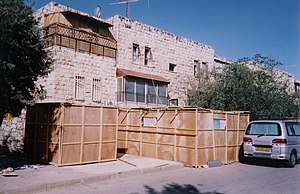
But few of these living things is more inspiring than the sight of the living practice of the biblical command to the Jewish people to "dwell in sukkot for seven days". All around Jerusalem you can see evidence of the commitment of the Jewish people to live up to this command -- in every neighborhood there are sukkot to be seen. Some high in the air, built on people's rooftops and apartment balconies. Some built on the ground in whatever open space people could find for the holiday. Nearly every restaurant -- even the most humble felafel stand -- has set one up, often right on the sidewalk, for people to eat in. Many of them are richly decorated (the picture on the left is of the inside of a sukkah where Minna is meeting some friends to sing with tonight). From many of them can be heard the sound of song as people meet to share meals together.

May it be the will of the Blessed Holy one that you will find shelter -- and peace and comfort and joy -- wherever you go.

Hag sameach.

Wednesday, October 15, 2008

Living on the edge

The sukkah -- that fragile, temporary, partially roofed hut that is characteristic of the holiday that began Monday night -- is not just supposed to be a place of joy and community, but also a reminder of the fragility of life and of the possibility of change. The holiday, itself, comes at a time of the turn of the seasons here in Israel. Yesterday was a pointed reminder that we are at that point of change. The daytime was unusually warm -- almost just like the long, rainless summertime here, again -- and it was a perfect time for us to sit in the shade of a friend's sukkah and enjoy food and company during a long afternoon lunch. But when evening came we were pointedly reminded that it is no longer truly summer as rain fell and chased people throughout Jerusalem out of their sukkot.

May it be the will of the Blessed Holy One that you should find the courage to welcome our fragility and to be open to changes and change. And may those changes bring you joy.

Moadim l'simcha!

Monday, October 13, 2008

Last chance (as the time of joy approaches)

In a week and a half, I will be returning to the States and Minna and I wanted to get one last trip out of Jerusalem together. I really had two places I wanted to go -- to return to the hills of Mt. Gilboa and I also wanted to see the famous mosaic floor of an ancient synagogue in Tiberias,

Even though it was not the season for Gilboa's famous Irises, it was still a treat to walk along its high ridge and see the views for miles around -- down into the Jezreel Valley and off across the Jordan river into the country of Jordan. The weather was almost perfect.

The drive down to the Kinneret (Sea of Galilee) was spectacular, although I think the best views of the day were when we were a bit lost trying to find the synagogue and ended up on this narrow road along the ridge above the Kinneret. I suprised Minna at one point by suddenly stopping. There was a turtle crossing the road who I did not want to run over.

The synagogue mosaic was really worth the visit. I had read much about the archeological and historical debates about how to understand an ancient work of art that both contains clearly Jewish symbols and pagan ones -- the zodiac! -- that you would think were theologically inconsistent with Judaism. It was so exciting to actually see this thing that I had read so much about.

It was especially interesting to see what Jewish symbols the artist had chosen to highlight. The most prominent one was the seven-branched menorah of the ancient Temple, but second only to that was a representation of a most central part of the holiday that is to start tonight -- the lulav and etrog of the holiday of Sukkot.

Sukkot is a particularly special holiday here in Israel. During the week of intermediary days -- called חול מועד/hol moed -- children are normally off from school and many parents are either also on holiday or working reduced schedules, resulting in a nation-wide festival atmosphere for both the secular and the religious Jew. It's one of those ways that modern-day Israel had developed to be something like what ancient practice was like: Sukkot was the greatest of the ancient festivals -- as reflected in the fact that the ancient mosaic artist chose to feature Sukkot's lulav and etrog instead of such other alternatives as Passover's matzah or Hannukah's eight-branched menorah -- and today modern Israeli practice has made Sukkot again perhaps the greatest festival.

The ancient rabbis dubbed sukkot זמן שחתנו/zman simchateinu -- the time of our joy. May it be the will of the Blessed Holy One that your days of Sukkot will also be filled with joy.

___________

Sunday, October 12, 2008

Quick Bread

I'm writing a quick post about the delicious quick bread I just had for breakfast. I've been computerless for a while now with my new computer arriving later this week (thanks, Mom and Dad and Diane!). Between that and the High Holy Days and maybe a touch of post-ulpan blues, my blogging life has been in the pits. BUT! I did want to sneak in a post about the very yummy banana, apple, date, no sucrose treat that Alan made in the oven. Necessity is once again being motherly and moving us (mainly Alan) to experiment with oven cooking (in our continuing gas-less state).
Today we're heading off in the car mostly to parts unknown. Har Gilboa? Tiberias? The Jerusalem Mall? Hopefully there will be a blog update on the day's adventures.
AND sometime between now and sunset tomorrow we also hope to buy lulav, etrog and be prepared for the wondrous rain dances of Sukkot.

Wednesday, October 8, 2008

No gas

Our stove here (as do most stoves in Israel, I believe) runs on cooking gas from a tank (somewhere!) outside our building. We ran out a few days ago and I don't know when we'll be able to get someone to deliver more (or even figure out which one of the tanks is ours; they don't appear to be labeled in any way).

You might think I would be upset about this as I have really enjoyed cooking during my time here. But, at least for the moment, I'm thinking of it as an adventure. We still have a pretty good oven. I'm traditionally the kind of cook who prefers to do most everything on the stove-top, but I can move my frittatas from the stove-top to the oven (even using the same cast iron pan!) . . . and discover other oven cooking options I've never used before.

Perhaps more importantly, we also still have a microwave! I expect to be consulting this Minimalist article about stretching the limits of the microwave quite a bit!

City by the sea, people before the gates

The sidewalk tables at a fashionable cafe, the ubiquitous presence of two-wheeled conveyances (both the people-powered bicycles and the gasoline-fueled scooters) -- these things you find in the above pic are typical elements, along with the warm Mediterranean sea, of the Tel Aviv Minna and I got a taste of in a short visit there this week shortly before Yom Kippur (which starts this evening!).

The Tel Aviv of today is a bustling, diverse and economically booming city. While the newspapers we read there very much reflected the concern that is rising worldwide over declining stock market prices and other elements of the current international financial crisis, one of the major questions the papers addressed was one that would only be asked by people who are still looking optimistically foward to how they will spend their money: how the crisis would affect Israelis' overseas travel plans. It turns out Europe is looking real good because of the strong Shekel, but the United States is still a bargain for Israelis as well.

We used our time here in Tel Aviv to mix work and play, using the cafes as (wireless internet-equipped) workplaces. We walked along about two miles of beachfront one late afternoon and evening to the South Street Seaport-like old port complex where we sat and drank coffee by the sea for a bit and reread (on my phone courtesy of the cafe's wireless internet connection) a New York Times travel section article on Tel Aviv that came out this past summer. It was interesting to read how the writer described things that we had seen now with our own eyes. He starts his article at the "separated beach", which men and woman use on alternate days to accomodate Orthodox concerns about men and woman bathing together. I wasn't expecting the visceral negative reaction I had to seeing the beach itself. I think it was probably because -- and I wasn't expecting this -- the beach is not only separated, but they have built a wall around it so you can't even see it (or the sea) from the beachside pathway.

We also took a daytime walk through some of the once-downscale neighborhoods in the south that are becoming gentrified. This plaza at a renovated school complex in the Neve Tzedek neighborhood was a perfect place for some folks (and their children and their dogs) to pass a peaceful late afternoon:
While we were sitting in one cafe near Neve Tzedek, Minna found a flyer for an organization that is working to advocate for the interests of non-religious couples in Israel. One of the unusual characteristics of Israel is that the Orthodox rabbinate controls matters of family law for Jews. This means it can be very difficult, for example, for some people to marry legally in Israel. This has led to the phenomenon of some Israelis flying to Cyprus just to get married (Israel, as part of the practice of recognizing marriages legally performed outside the country, recognizes these marriages as legal). The organization is called משפחה חדשה/mispahah hadashah, or New Family.

I really enjoyed our time in Tel Aviv. Jerusalem has the spiritual force and focus that attracts me -- and countless others -- there for study and spiritual growth. But the future health of the state of Israel -- something very dear to my heart -- will depend much more on what happens in Tel Aviv than Jerusalem. It is here that Israel strives for its success in the "knowledge economy" that has become the key for success -- especially for a very small country without much in the way of natural resources -- in the world marketplace. Here are high-tech engineers and dealmakers. Here are the artists and media creators who can make export their products (like Betipul) to foreign markets.

__________________

More than once since I have been here in Tel Aviv I have felt reminded of the war that started on Yom Kippur exactly 35 years ago and that cost Israel dearly in lives lost before the invaders were beat back. As we enter Yom Kippur -- the holiday that more than any other in Judaism asks us to contemplate our own mortality -- I wish for peace for all. May war once and for all disappear from our earth and may it be the will of the Blessed Holy One that we will all come to see the wisdom of the peaceful ways in which the Holy One has instructed us.

[x-posted to abayye]

Sunday, October 5, 2008

Where the animals and the people play


Minna and I managed to get out of Jerusalem this afternoon for the first time in a bit. We headed east to Ein Gedi (above is a view from where we hiked to; there's an ibex in the distance to the right and the Dead Sea -- the lowest point on earth at some 400 meters below sea level -- in the background). [You can click on the image for a better view.]

Israel is largely a desert country, so spots with water you can play in -- like the pools of Ein Gedi -- are prized. Ein Gedi even has some waterfalls. That's Minna (on your right) standing below the biggest one, David Falls.

After we left Ein Ged -- where the ibex play -- we went to a couple of malls -- where the people play.

First we went to Maale Adumim, which is a very large -- and highly controversial -- Jewish settlement of over 30,000 people to the east of Jerusalem. Minna was struck by just how ordinary this place of so much contention seemed to her. We stopped in a mall there and got a cup of coffee and walked around. Then we went for a bit of a walk in the surrounding neighborhood. We found ourselves in a low-lying park that was populated by some of these guys of all things:


Then we headed back to Jerusalem to the mall and got some kosher Burger King, which was a real treat.

Here are some more pictures from Ein Gedi, etc.:

Here's a woman enjoying the scene by one of the other waterfalls while a friend swims in the pool by her:

Here are a couple of more pics of the ibexes on the ridge:


Here's a nice pic of Minna and me taken by the David Falls:


And here's Minna looking contemplative in Maale Adumim:

Friday, October 3, 2008

Death of a Leader

Minna traveled to Jerusalem in search of opportunities for study and to experience joy in this ancient (and now modern) home of the Jewish people. But sad events can follow us wherever we go. Yesterday, we found ourselves at a funeral for the father of one of Minna's most beloved teachers in her rabbinical school at Boston Hebrew College. The funeral was at Jerusalem's main municipal cemetery, Har HaMenuhot, pictured to the right. It's built around a huge hill on the northwest side of Jerusalem, just south of the main road to Tel Aviv. There were quite spectacular views to the north from the burial site.

The funeral was attended by many of Minna's classmates. I found the below picture on a memorial page to the deceased, Zelig Leader. From right to left is Zelig, his son Ebn (Minna's teacher) and Art Green (the leader of Minna's school).

In the Israeli fashion, the words spoken at the funeral were short and intense. Ebn spoke first and, very much in his style, led the assembled in the wordless tune of a niggun.

I did not know Zelig, himelf, but I very much knew of the famous "Leader Minyan" here in Jerusalem, which is known for the intensity and length of its Shabbat and holiday services and which has been an important spiritual home for many American rabbinical students and others coming to spend a year or so in Jerusalem. I was suprised therefore that the second speaker was not a participant in the minyan, but was a leader in the Jerusalem scrabble club who spoke in English. Apparently, Zelig's inspirational spirit was an important force there as well.

Zelig's youngest son also gave a powerful and tearful talk, begging for forgiveness. Zeglig's brother also spoke powerful words.

After the words of those הספדים/hespidim were spoken, Zelig's body was carried out by members of the black-hatted הברה קדישא/hevre kasisha (burial society) on a stretcher wrapped in a burial shrowd (no coffins are used here in Israel). The stretcher was placed in a van that we walked behind to the burial site where he was laid to rest in the presence of his family and friends.

May his memory be a blessing.

[x-posted to abayye]